Newly discovered standing stones in France shed light on the ancient megalith builders
The Art Newspaper
August 12, 2026
© Alexandre Rosa
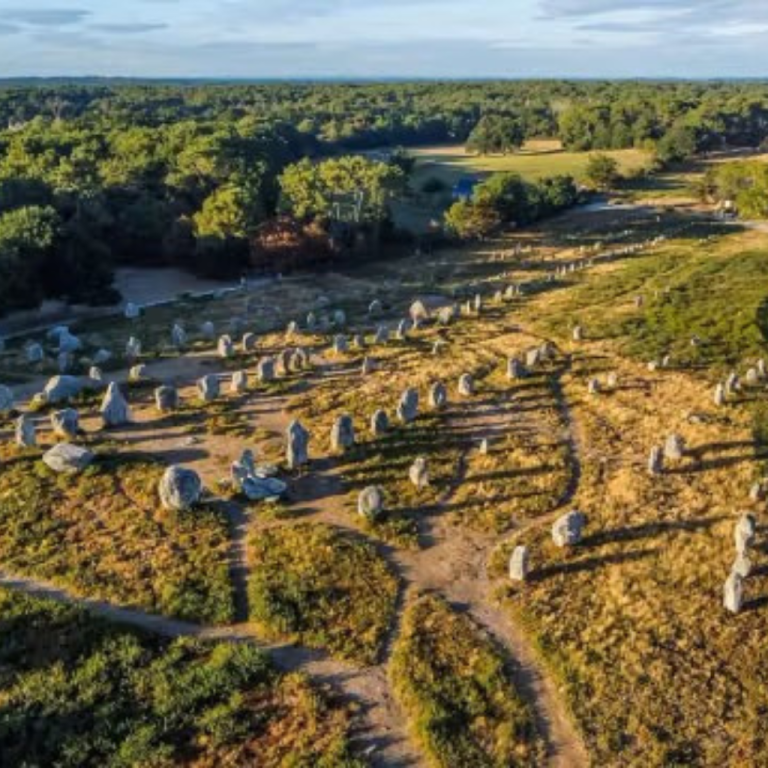
Archaeologists in Carnac, northwest France, have used aerial drones to identify previously unknown stones buried beneath the surface.
Over 6,000 years ago, farmers in Brittany, western France, erected around 3,000 stones in long rows, stretching for more than 4km across what is today the town of Carnac.
These builders made sure to place shorter stones at the east side of the arrangement and taller ones to the west, some standing nearly 4m tall, and erected others in the shape of semicircular and rectangular enclosures.
They also built hearths beside the stones’ irregular granite forms, perhaps for cooking or simply for light, and buried their dead beneath mounds of earth and megalithic tombs across the sacred landscape.
But what did Carnac’s mysterious standing stones mean to these early builders? Were they a way of monitoring the movements of the sun and moon? A colossal calendar? Or were they the petrified bodies of soldiers, as one 17th-century legend relates. For archaeologists trying to understand the site, any new piece of the puzzle could help provide an answer.
This mystery has long endured, partly because there has been little excavation at Carnac compared with most archaeological sites of this significance. Individuals conducted sporadic excavations before the 20th century; and even then, except for archaeological investigations from the 1920s to the early 1940s, the aim has mainly been a place to preserve and protect.
Its global significance was cemented in 2025 when the Megaliths of Carnac and of the shores of Morbihan were inscribed on Unesco’s World Heritage list.
Related articles
The Art Newspaper
- World's oldest known rock art discovered in Indonesia (January 2026)
- First Americans may have sailed from north-east Asia (November 2025)
- Ancient stone carvings on Hawaiian beach (August 2025)
- Mysterious megalithic sites in Carnac, France may be among the oldest in Europe (July 2025)
- Malta's mysterious prehistoric temples may have taught sailors to navigate by the stars (June 2025)
- After a volcanic eruption, ancient Danes offered sun stones to the gods to bring back the light (January 2025)
- Rare ancient rock art found in Saudi Arabian lava tube (July 2024)
- Archaeologists in Peru identified one of the oldest megalithic structures in the Americas (March 2024)
- Yatch rock art: prehistoric carvings found in Norway may be oldest nautical images in the world (May 2021)
- Boat carvings found in Norway may be the oldest in Europe (April 2021)
- Mysterious stone structures in Saudi Arabia are around 7,000 years old (April 2021)
- Hear the sound of an ancient conch horn, played again after 18,000 years (February 2021)
- Discoveries at Stonehenge highlight controversial new tunnel's threat to heritage (February 2021)
- Voluptuous Venus figurines may have helped prehistoric Europeans survive the Ice Age (December 2020)
- Is the Nebra Sky Disk a millennium younger than we thought? (September 2020)
- Fingerprints help identify prehistoric painters (September 2020)
Science Magazine
Timeless Travels Magazine
- Ancient Orkney, Centre of the Neolithic World (Spring 2017)
- Malta: Island of Giants (Autumn 2015)