Great Pyramid of Giza vandalised
The Art Newspaper
February 20, 2014
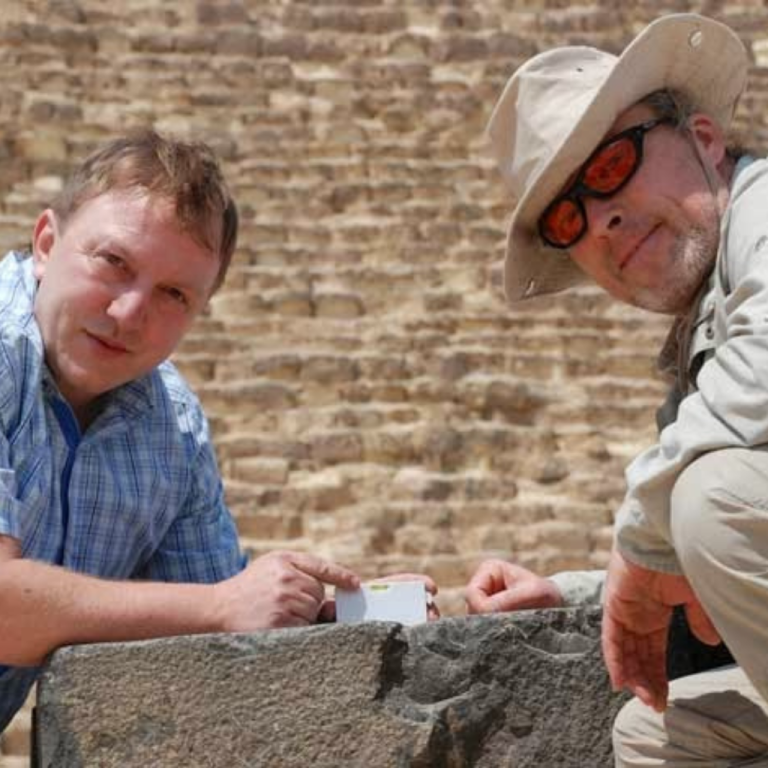
© Dominique Goerlitz and Stefan Erdmann
German researchers allegedly scraped pigment from a pharaoh’s cartouche, in an attempt to prove it is a forgery.
Following accusations of vandalism and theft at the Great Pyramid of Giza, two researchers are under investigation in Germany and six individuals have been detained in Egypt, including the head of a tour company, archaeologists and local guards.
Officials with the Ministry of Antiquities responsible for the pyramids have reportedly already been transferred to other positions as punishment for negligence.
In April 2013, Dominique Goerlitz and Stefan Erdmann are suspected of having illegally scraped samples of pigment and stone from one of the uppermost chambers of the Great Pyramid, focusing their attention on a red ochre cartouche of King Khufu.
Most scholars date this mark to the pyramid’s construction in around 2500BC, while alternative theorists, including the two German researchers, have long claimed the cartouche to be a fake, painted by its discoverer, Colonel Howard Vyse in 1837 to help him secure further funding for his explorations. To prove their claims, Goerlitz and Erdmann allegedly smuggled the pigment samples from Egypt to Dresden University for further study; by proving the modernity of the pigment, they hoped to raise the possibility that the Great Pyramid was constructed by a civilization much older than the ancient Egyptians.
Their hopes of rewriting history were dashed in November, however, when a self-posted trailer on YouTube for a documentary detailing and revealing their exploits, drew almost universal condemnation and angered Egyptian authorities. After the controversy broke, the German embassy in Cairo released a statement emphasising that neither Goerlitz nor Erdmann were associated with the embassy or the German Archaeological Institute.
The researchers, who have no archaeological training, also had no affiliation with Dresden University, although they approached one of its laboratories to study the samples taken from the pyramid. The university lab has since stated that it was unaware of the samples’ origin, and now wishes to return them to Egypt. Nonetheless, Mohamed Abdel Maqsoud, the head of the Pharaonic Antiquities section of the Ministry of Antiquities, has stopped any future cooperation with Dresden University, saying that the German researchers broke Egyptian law when they took the samples without permission.
In December, both Goerlitz and Erdmann apologised for their behaviour in a letter addressed to Egypt’s Ministry of Antiquities, offering to pay compensation for the damage and stressing that they did not mean harm to the pyramid. Egypt’s head of antiquities, Mohamed Ibrahim, has so far rejected their apology.
Related articles
The Art Newspaper
- Egyptian's tweet to save their heritage from looting (September 2013)