Can a new cipher help to explain the mysterious Voynich Manuscript?
The Art Newspaper
January 7, 2026
© Beinecke Rare Books and Manuscript Library
A researcher's encoding method may shed some light on the 15th-century codex.
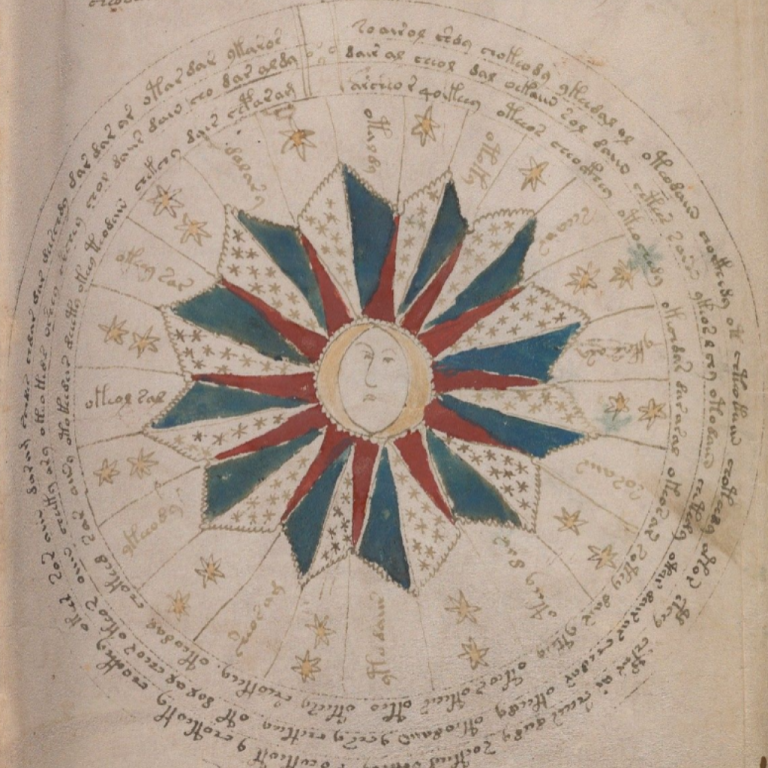
A researcher has developed a cipher that might provide insights into how medieval scribes produced the Voynich Manuscript’s unreadable writing.
Created in the early 15th century, and often called the world’s most mysterious manuscript, the Voynich Manuscript bears unusual illustrations and illegible writing in a unique script.
When statistically analysed, “Voynichese”—as the script is known—reflects some characteristics of a typical language, but in other ways, behaves strangely. This has led experts to argue that its text could be an unknown or artificial language, gibberish, or a cipher.
Now, the science journalist Michael A. Greshko has developed an encoding method that replicates some of the unusual features of “Voynichese”. He has called this the Naibbe cipher, after a card game known in Italy in 1377.
“This encoding method leads to a decipherable secret message consisting of ‘words’ whose internal structures, lengths, and frequencies replicate what is observed within portions of the Voynich Manuscript,” says Greshko, the author of a research paper published in the journal Cryptologia.
Related articles
Yale University Press
- Cryptic: From Voynich to the Angel Diaries, the story of the world's most mysterious manuscripts (May 2025)
The Art Newspaper
- The Voynich Manuscript revealed: Five things you didn't know about the Medieval masterpiece (May 2025)
- Voynich Manuscript scans reveal early decoding attempt (September 2024)
- Trove of coded letters written by an imprisoned Mary Queen of Scots are cracked (February 2023)
- Unknown history of 600-year-old, coded Voynich Manuscript revealed by researchers (January 2023)
- Lost star catalogue found hidden on the pages of a medieval manuscript (October 2022)
- The Voynich Manuscript's mysteries endure more than a century after its discovery (August 2022)
- Fascinated by the Voynich Manuscript? Here are some other mysterious texts you can decode (July 2021)
- The write stuff: new analysis on Dead Sea Scrolls sheds light on the scribes behind them (April 2021)
- Has Yale's mysterious Voynich Manuscript finally been deciphered? (June 2020)
SC Exhibitions
- John Dee at the Royal College of Physicians (May 2016)