Hildegard of Bingen's Unknown Language and Unknown Letters
World History Encyclopedia
June 10, 2025
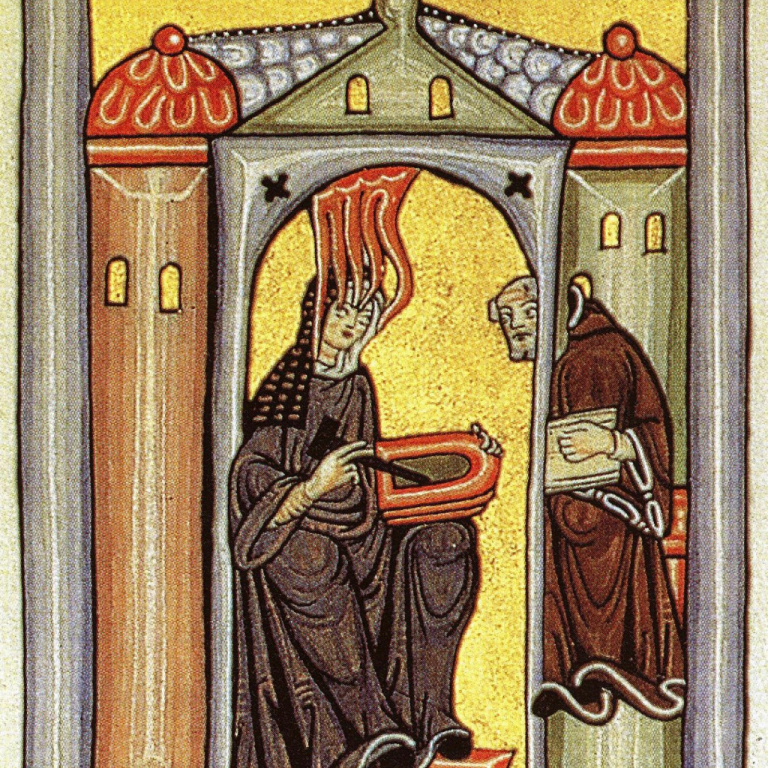
© Eisenacher-commonswiki (Public Domain)
Sometime in 1153 or 1154, the German nun Hildegard of Bingen (1098-1179) wrote a letter to the elderly Pope Anastasius IV (1073-1154).
Her words were scathing. She called the pope tired and criticized his rule, describing him as too accepting of depraved people and urging him to control the arrogance of those around him.
There was corruption in the medieval church, Hildegard asserted, and he, as pope, should be doing something about it.
Hildegard did not hold back her anger; but among her many complaints, she included an unusual throw-away comment – a reference to one of the greatest mysteries of her life: she told Anastasius that she had witnessed a miracle, an experience that led her to create Unknown Letters and to speak an Unknown Language (lingua ignota and litterae ignotae in Latin).
These mysterious creations remain little understood today, and scholars continue to debate their purpose.
Related articles
The Art Newspaper
- The Voynich Manuscript revealed: Five things you didn't know about the Medieval masterpiece (May 2025)
- Voynich Manuscript scans reveal early decoding attempt (September 2024)
- Trove of coded letters written by an imprisoned Mary Queen of Scots are cracked (February 2023)
- Unknown history of 600-year-old, coded Voynich Manuscript revealed by researchers (January 2023)
- Lost star catalogue found hidden on the pages of a medieval manuscript (October 2022)
- The Voynich Manuscript's mysteries endure more than a century after its discovery (August 2022)
- Fascinated by the Voynich Manuscript? Here are some other mysterious texts you can decode (July 2021)
- The write stuff: new analysis on Dead Sea Scrolls sheds light on the scribes behind them (April 2021)
- Has Yale's mysterious Voynich Manuscript finally been deciphered? (June 2020)
SC Exhibitions
- John Dee at the Royal College of Physicians (May 2016)