Collapse of Ancient Maya civilization coincided with 13-year-drought
The Art Newspaper
August 13, 2025
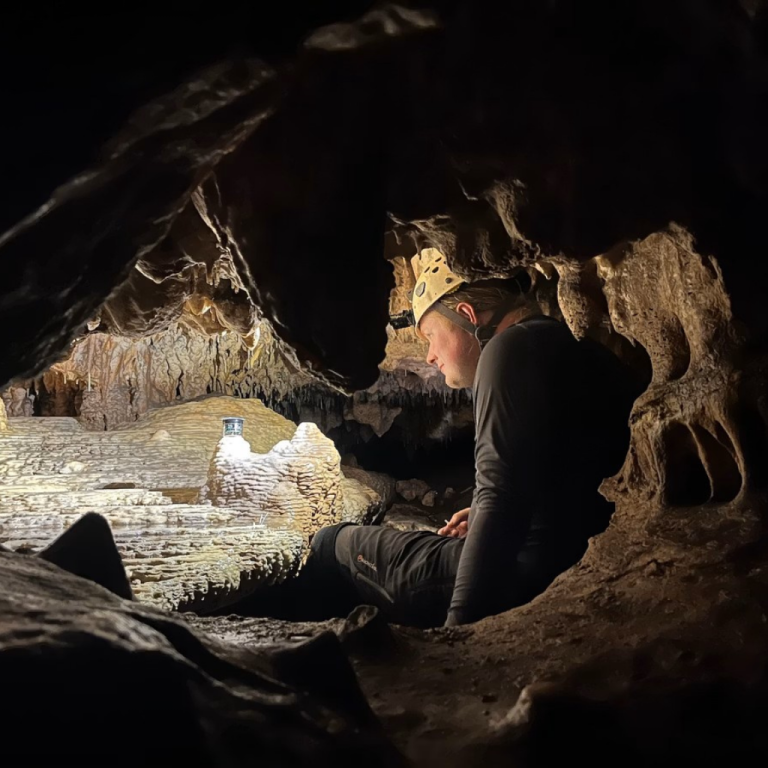
© Sebastian Breitenbach, 2022
New research based on stalagmite analysis suggests a historic drought may have contributed to the society’s decline.
A 13-year drought may have played a role in the collapse of ancient Maya civilization. By analysing a stalagmite found in a Mexican cave, researchers collected climate data for the years 871 to 1021—a time of decline for Maya society.
The rainfall levels revealed that the ancient population suffered through repeated periods of severe drought during what should have been wet seasons.
“What surprised us was how clearly the seasonal cycle was recorded, it’s highly unusual to be able to access past climate information at such a high-resolution,” Daniel H. James, a postdoctoral researcher at University College London, and lead author of the research paper, tells The Art Newspaper. “
To be able to generate a sub-annual climate record that spans such a societally important time is a very rare and exciting opportunity.”The reasons for the decline of Classic Maya civilization—which happened between 800 and 1000 and is sometimes referred to as the Maya collapse—have long been debated among experts. Changing trade routes, war, civil unrest, disease and severe drought have all been cited as possible contributing factors. Now, James and his colleagues have added extra evidence for the impact of droughts.
Related articles
The Art Newspaper
- More than 100 archaeological structures discovered in the Peruvian Andes (May 2025)
- Explosive volcanic eruption may have led to growth of ancient city of Bolivia (January 2025)
- After a volcanic eruption, ancient Danes offered sun stones to the gods to bring back the light (January 2025)
- Ancient throne room of powerful Moche woman discovered in Peru (October 2024)
- Archaeologists in Peru identified one of the oldest megalithic structures in the Americas (March 2024)
- Layout of ancient stilt village in the Amazon may have been based on Pleiades star cluster (August 2023)
- 'Thunder floor' found at ancient Andean site in Peru (July 2023)
- Ancient ritual complex uncovered in Peru (February 2023)
- Machu Picchu may be decades older than previously thought (August 2021)
- How a ceremonial shrunken head, held by a US university for decades, was finally returned to Ecuador (May 2021)
- Mummified llamas, sacrified to the gods by Incas, uncovered by archaeologists in Peru (October 2020)
- High school student leads archaeologists to lost Inca settlement (September 2020)
- Exploding volcano mural could be world's oldest landscape (January 2014)