Ancient Andean hunting traps in Chile revealed by satellite imagery
The Art Newspaper
October 12, 2025
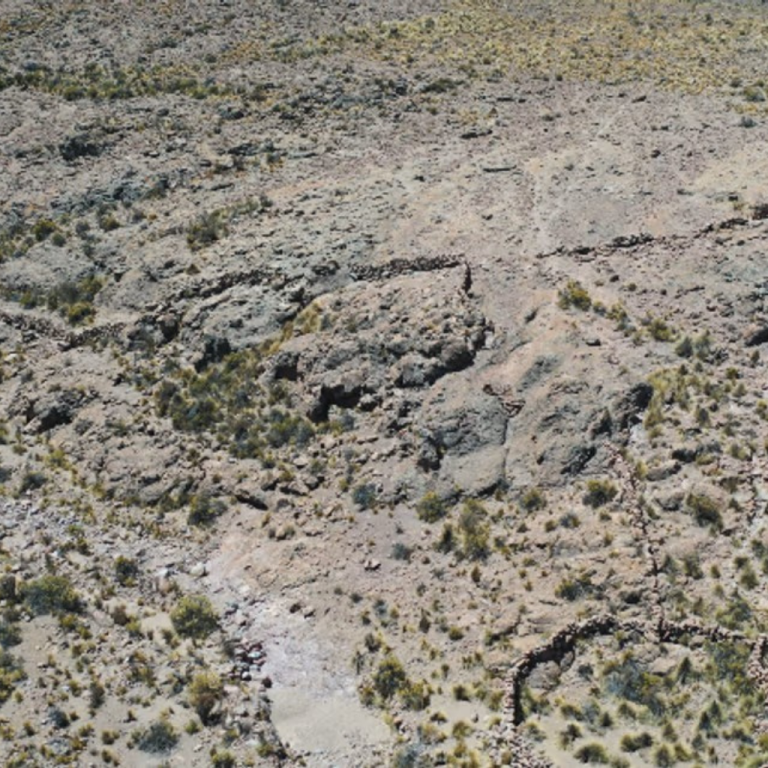
© Adrián Oyaneder
The discovery indicates that the hunter-gatherer lifestyle persisted in the highlands for thousands of years longer than was previously thought.
An archaeologist has used satellite imagery to identify ancient hunting traps in the Andean highlands of northern Chile.
Known as chacu, the large traps helped communities drive their prey into deep pits, and may show that hunter-gatherers continued to live in the region for far longer than was previously believed.
“Prior to my research, fewer than a dozen such traps were known across the entire pre-Hispanic Andes,” Adrián Oyaneder, author of the research paper and an archaeologist at the University of Exeter in the UK, tells The Art Newspaper. “
However, in parallel with a French research team, I was able to demonstrate that these structures are heavily concentrated in the Camarones Valley, where we documented 76 examples with strong indications of at least 100 more further to the south.”
When building their traps, Andean hunters usually followed a funnel-shaped design. Often constructed on steep hill slopes, the traps consist of two or more long dry-stone walls, with a dominant “arm”, on average 181 metres in length, and a shorter one of around 97 metres.
The space between these arms narrows as they head downhill, forcing animals to move from higher ground towards a two-metre-deep drop, where they would fall into a structure designed to contain them. In the Andes, hunters typically used such traps to capture wild camelids, particularly vicuñas, a relative of the alpaca.
Related articles
The Art Newspaper
- Analysis of ancient string writing device upends understanding of Inca hierarchy (August 2015)
- Collapse of ancient Maya civilisation coincided with 13-year drought (August 2025)
- More than 100 archaeological structures discovered in the Peruvian Andes (May 2025)
- Explosive volcanic eruption may have led to growth of ancient city of Bolivia (January 2025)
- After a volcanic eruption, ancient Danes offered sun stones to the gods to bring back the light (January 2025)
- Ancient throne room of powerful Moche woman discovered in Peru (October 2024)
- Archaeologists in Peru identified one of the oldest megalithic structures in the Americas (March 2024)
- Layout of ancient stilt village in the Amazon may have been based on Pleiades star cluster (August 2023)
- 'Thunder floor' found at ancient Andean site in Peru (July 2023)
- Ancient ritual complex uncovered in Peru (February 2023)
- Machu Picchu may be decades older than previously thought (August 2021)
- How a ceremonial shrunken head, held by a US university for decades, was finally returned to Ecuador (May 2021)
- Mummified llamas, sacrified to the gods by Incas, uncovered by archaeologists in Peru (October 2020)
- High school student leads archaeologists to lost Inca settlement (September 2020)
- Exploding volcano mural could be world's oldest landscape (January 2014)