Archaeology can offer lessons for future space colonies—but we must protect existing lunar heritage first
The Art Newspaper
August 18, 2026
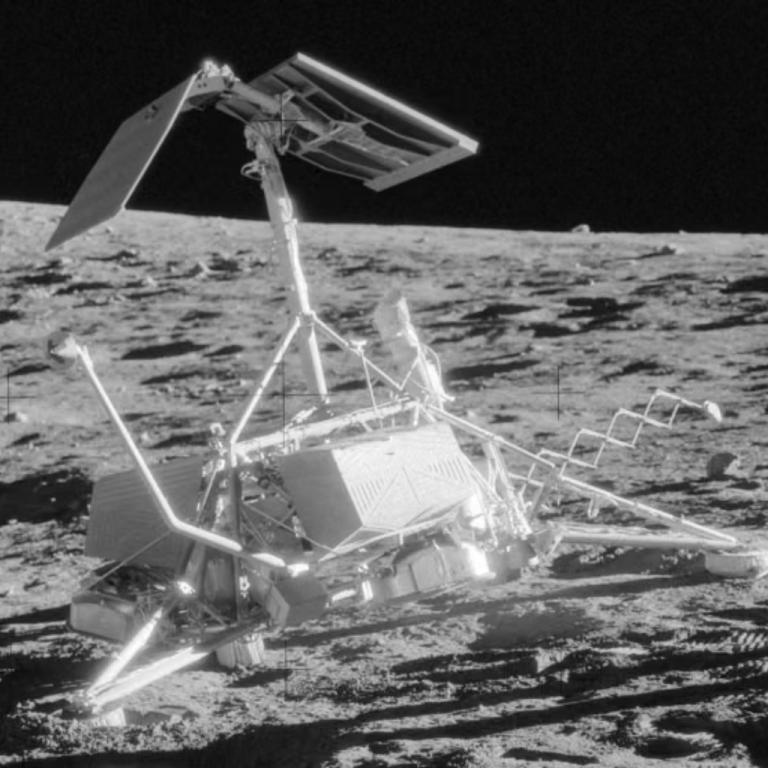
© Photo Nasa (Wikimedia Commons)
A new study reveals how island archaeology could guide future colonists to Mars, Jupiter and beyond, however the traces of past endeavours are at risk.
On 19 November 1969, Apollo 12 landed on the moon.
Without the astronauts realising, the rocket exhaust that slowed their lander’s descent threw up moon dust with such intensity that it “sandblasted” the 1967 Surveyor 3 probe, 155m away, leaving parts of it pitted with craters. It is a striking example of how far and fast lunar dust is flung by landing spacecraft—and a warning that, even on the moon, cultural heritage is not safe.
Faced with such challenges, in 2011 Nasa published its recommendations for protecting US government lunar artefacts. Any descending spacecraft is advised to respect a 2km exclusion zone from their heritage landers—for example, keeping the site of Neil Armstrong’s “one giant leap for mankind” protected from dangerous high-velocity moon dust.
But as experts have explained, this distance was always just a placeholder, meant to be revised after further research. The true safe distance might be much further.
And this is not the only problem. The many issues surrounding the preservation of lunar space heritage were recently summarised in a paper by Teasel Muir-Harmony of the Smithsonian National Air and Space Museum and Todd Mosher of the University of Colorado. Significantly, as they note in the journal Acta Astronautica, “There is currently no international heritage law that applies to historic or future sites on the moon.”
Related articles
The Art Newspaper
- Recent discoveries reveal how natural disasters shaped past civilisations: can it help us plan for the future? (April 2026)
- Climate change is forcing tough choices - how much heritage can we save before it is too late? (March 2026)
- Climate change is destroying archaeological sites before we can study them, scientists warn (November 2022)
- Historic churches of Naples are at risk from sinkholes (November 2020)
SC Exhibitions
- Cosmonauts: Birth of the Space Age Exhibition Review (December 2015)