Hundreds of ancient coins and inscribed pottery fragments discovered at Byzantine site in Egypt
The Art Newspaper
July 9, 2026
© Ministry of Tourism and Antiquities
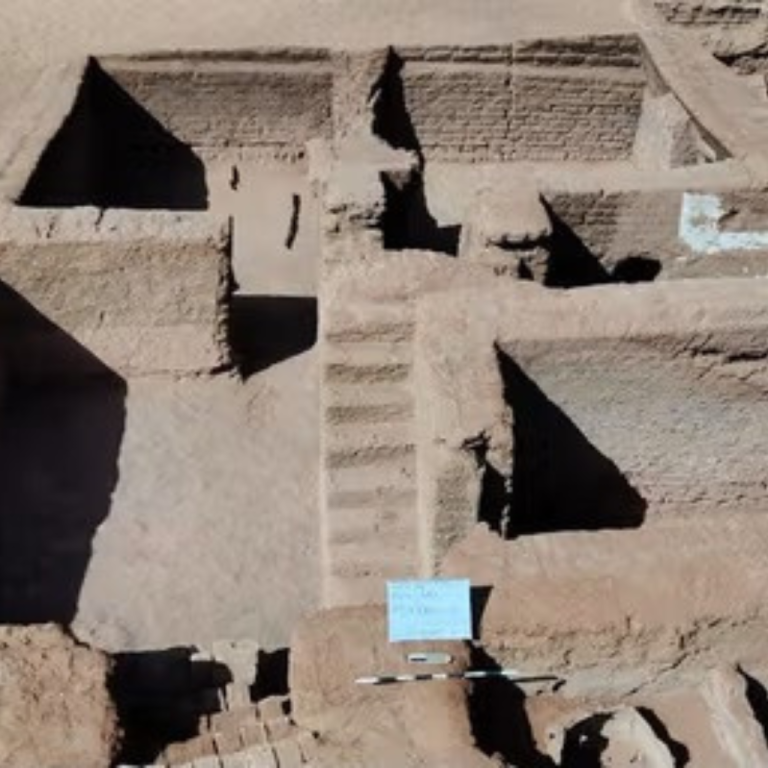
The 'Ain al-Sebil site in the Dakhleh Oasis had an organised village plan, with a fortress, watch towers and a fourth-century basilica at its centre.
Egyptian archaeologists working at Dakhleh Oasis, 565km south-west of Cairo, have excavated a mud-brick settlement, revealing hundreds of inscribed pot sherds, bronze and gold coins, and religious and domestic buildings.
These findings will help experts to reconstruct daily life at the oasis during Egypt’s Byzantine era, which lasted from roughly AD284 to AD641, and highlight the desert region’s rich cultural heritage.
“The excavations are important because many settlement sites are under threat from agricultural expansion, it is well preserved and is yielding significant finds,” the archaeologist Colin Hope of Monash University, Australia—an expert on Dakhleh Oasis who was not involved in the excavations—tells The Art Newspaper.
“Like other locations in Dakhleh, it is revealing the wealth of the agricultural communities, their interconnections locally and nationwide. There would have been many such communities throughout Dakhleh of smaller size.”
Related articles
The Art Newspaper
- Ancient Egyptian queen's statues were not destroyed out of hatred but 'deactivated', study finds (June 2025)
- Ancient Egyptian priestess's remains found in father's tomb (November 2024)
- 'An important chap': archaeologists in Egypt discover tomb of an ancient royal treasurer (November 2021)
- Egyptian archaeologists make 'the biggest discovery of 2020' (November 2020)
- Trove of 'perfectly preserved' painted coffins and mummies discovered at ancient Egyptian necropolis (October 2020)
- Possible unmapped chambers discovered near Tutankhamun's tomb (May 2019)
- Archaeologist uncover ancient Egyptian princess's tomb in Dashur (May 2017)
- Egypt announces 'discovery of the century' hidden behind King Tut's tomb (March 2016)
- Signs point to two hidden rooms at Tutankhamun's tomb, experts say (September 2015)
- A mummy family reunion (April 2014)
- Egyptian Pharaoh's tomb discovered by American archaeologist (January 2014)
- Ancient physician's tomb discovered in Egypt (October 2013)
Thames & Hudson
Unseen Histories
Apollo Magazine
- The Importance of Death in Everyday Egyptian Life (February 2016)
History Today
- The Afterlife of Ancient Egypt (February 2016)
Rawi: Egypt's Heritage Review
- Akhenaten's Akhetaten: A day at Tell el-Amarna (June 2012)