El-Qurna: Exploring Luxor's 3,500-Year-Old Cemetery that was also home to the living
Current World Archaeology
June 2014
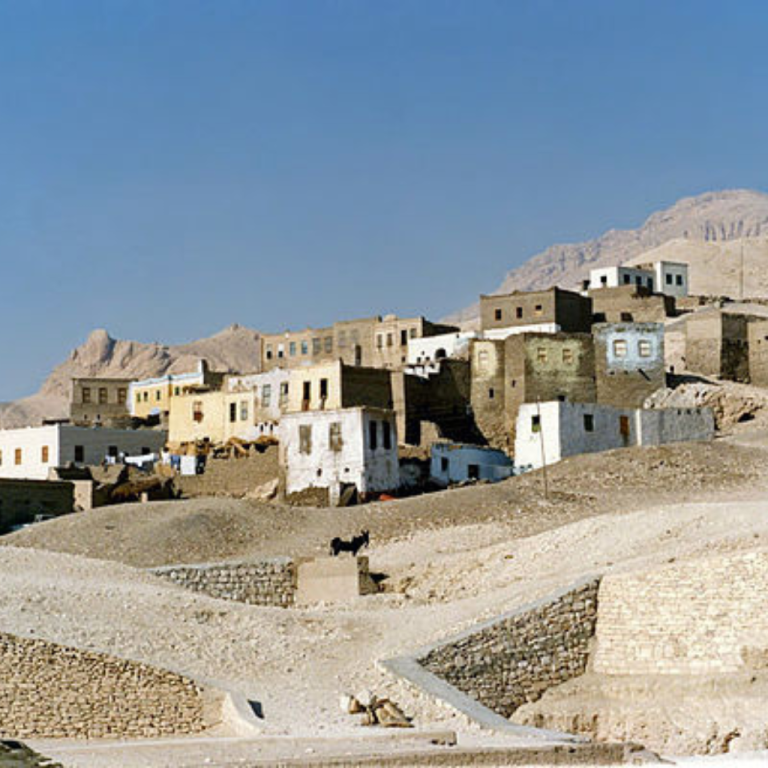
© Bernard Gagnon CC BY-SA 3.0
Sheikh Abd el-Qurna on the west bank of the Nile at Luxor is a huge necropolis that dates back at least three millennia, perhaps further, to the earliest burials of the ancient elite of Thebes.
It was also home to the living, as attested by the recently demolished jumble of hamlets that were once strewn atop the tombs.
Now the American Research Center in Egypt (ARCE) is working to understand both the ancient and the modern history of el-Qurna, a project that involves the local community and, as a result, is creating much-needed employment in the area following the collapse of the tourism industry. Since October 2012, the Qurna Site Improvement (QSI) project, managed by ARCE, is recording the remains of the hamlets that once stood on the Theban foothills.
The major impetus behind this fieldwork is the manual clearance of debris left over from the demolition of the hamlets of el-Qurna and el-Khokha, which were built across and on top of the site’s ancient tombs; both hamlets were destroyed as part of a countrywide policy of removing modern buildings from archaeological sites between 2007 and 2010. Though now largely lost, these mud-brick houses are as much a part of the site’s history as the ancient burials, especially as their architecture had, over time, become inextricably fused with the tombs.
Thus, understanding this modern history is a priority for the ARCE team: while removing the rubble by hand, to make the site safer and less chaotic, they are recording the hamlets’ remains and collecting ethnographic data about their inhabitants, ensuring that Qurnawi culture and customs – both rapidl vanishing – are preserved for posterity.
Theban necropolis
The QSI project is the latest in a long line of archaeological explorations at Luxor, though it is one of the few to treat the recent history of el-Qurna with as much interest as its ancient past. The earliest narrative of a European visiting Luxor is that of ‘the Unknown Venetian’, whose account was written in 1589.
In it, he mentions the aggressive nature of the west bank’s population, and how ship captains preferred to avoid them by disembarking on the Nile’s east bank. This belligerent behaviour is also mentioned by later travellers, and was perhaps a result of the local people guarding their wealth: the plentiful and lucrative supply of mummies from the necropolis, which they sold on to traders as powdered mumiya for use in medicines.
At this time, it appears that there was no permanent settlement either at el-Qurna or the neighbouring hamlet at el-Khokha; instead, the local population occupied the Theban tombs for just part of the year – and when seeking refuge from Ottoman attacks. This all changed in the late 18th century, when Thebes came to the attention of a European scientific community eager to acquire antiquities for their studies and museums.
It is thought that the Greek 19th-century explorer, Giovanni d’Athanasi (called ‘Yanni’) built the first free-standing house at el-Qurna, and that his presence inspired locals to settle permanently above the ancient tombs. In Athanasi’s wake, foreigners – explorers, archaeologists, treasure-hunters, and tourists – would become a constant presence on the Theban foothills, from ‘The Great Belzoni’ and Howard Carter, through to the ARCE team working there today.
As time passed, the hamlets grew, each developing a unique identity and their own local traditions. With a concession covering an area roughly 1km2 in size, divided into 29 sections (each prefixed by the letter ‘Q’), fieldwork at el-Qurna always promised to be a massive undertaking. Surprisingly, however, so was preparing for it. The greatest shock was that a site as famous as the Theban necropolis – and a UNESCO World Heritage Site since 1979 – had never been properly surveyed.
Into the field
When ARCE field director Dr Andrew Bednarski began developing the QSI project, he realised that there was no accurate modern map that covered the whole area. There was only one solution: to produce a new map, one that not only accurately recorded the topographic and historical features, but which would also reflect different interpretations of the landscape.
The ARCE team consulted the local people, and discovered that though Egyptologists had traditionally divided the hamlets of the Theban foothills between el-Qurna and el-Khokha, the Qurnawis themselves actually split them according to kinship. Thus, plotting these divisions onto a map, the team revealed not two but four major sectors: el-Rasayla, Habashi, el-Tamalaya, and Hurubat, each associated with a separate family.
Of these, the Abd el-Rasouls were the owners of houses at el-Rasayla, for example, while the families of Hurubat all believed themselves to be descended from a founding father named Harb. Such findings – which provide fascinating cultural details that would surely otherwise have been forgotten within a couple of generations – highlight the importance of community involvement and local knowledge to any archaeological project.
One of the most fascinating aspects for the ARCE team when clearing the site is what is being revealed about everyday life at el-Qurna. Especially interesting are the ways in which the Qurnawis adapted their houses to take into account the landscape and the ancient tombs. Many houses across el-Qurna and el-Khokha incorporated the rock-cut tombs into their structures, often being built within the walled forecourts that mark the entrance to the ancient burial chambers.
A good example of this is Q08 Structure 1, the former home of a man called Hanafy Abd el-Taher and his family, and one of the houses recently cleared on the necropolis. Here, the ancient forecourt was divided up into pens for animals, while the bedrock had been modified to create an upper floor. The ancient tomb associated with the house was accessible from the ground floor, and part of it was used as the household toilet – a common practice at el-Qurna.
Such an arrangement was also seen at one of the site’s largest buildings: the Snake Motel. The motel, in section Q05, had been built within the tomb forecourt of a man called Hunefer, an official who lived during Egypt’s Ramesside Period (1298-1069 BC). The team also found that some houses at el-Qurna had been illegally expanded, despite official bans on such activities and government monitoring to halt these practices.
Evidence of one method of avoiding the watchful eyes of the authorities was seen in Q11, at the house of Abd el-Baset: an animal pen was built, and was used until its presence had become accepted by all; then, during the night, it was rebuilt using stronger materials. The pen could then be used as an additional room for the household. From cooking pots and drinking jars, to aroosa dolls that were sold to tourists, the remains of the hamlets’ material culture are also being revealed to the ARCE team.
Clearing a house in section Q05, they found an invitation card from relatives of the Basily family, who lived in the house, inviting them to Cairo to attend a funeral. And, attached to the house of Abd el-Baset in Q11, they found limestone debris, evidence of a limestone-carving industry that saw local artisans replicating ancient tomb scenes for tourists. Perhaps most intriguingly of all, when working in Q11, the team discovered a collection of magic spells, which they analysed with the help of a local sheikh.
One, written for a man named Ahmed Ibn Nawal, compelled people to purchase items from his market stall, while others encouraged conception. Conversely, a spell identified as ‘Taskaret Dawod’ was designed to render a man impotent, and included a symbol which represented a djinn (genie), who drew his power from stars roughly sketched around the page.
Future aims
Though the main goal of the ARCE team was to bring employment to Luxor’s west bank of the Nile, when complete the QSI project will leave the ancient necropolis visually less disturbed, and with better access to the ancient monuments for visitors.
The project’s long-term impact on archaeology will also be considerable, as Dr Bednarski explains: ‘This is the first comprehensive study of a rural Upper Egyptian modern settlement, including an entire ceramics corpus and evidence for building techniques.
Rural life in Egypt is changing at a rapid pace, so it is important to record this information, which is quickly disappearing throughout the country.’ Archaeology has long provided a means of support for the people of el-Qurna. Although their relationship with this archaeology has now changed, the Qurnawis’ lives, like that of the houses in which they once lived, remain entangled with the ancient remains.
Related articles
The Art Newspaper
- Colossal kings rebuilt in Luxor (April 2014)
- Egyptian princess sculpture unearthed in Luxor (March 2014)
- Exploding volcano mural could be world's oldest landscape (January 2014)